Updated June 5, 2026: This article was originally published in 2009. It has been expanded with additional context on People Express, Spirit Airlines, basic economy, and the modern unbundled airfare model, while preserving the original history links and video references.
Get Flight Wisdom by email Practical answers on air travel, delays, cancellations, refunds, baggage and more
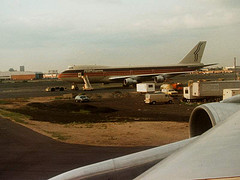
We’ve been really enjoying this history kick we’ve been on of late. So, newsflash…July 31st, 1986.
The Associated Press reports that Newark-based People Express will eliminate service to eight cities and change its pricing structure and policies, as well as lease eight 727-200 aircraft to another airline. It was the largest reduction in service thus far for the then five-year-old carrier.
At the time, that was a story about a struggling young airline cutting back. With a few decades of distance, it looks like something more interesting: an early warning about the promise and danger of the low-fare airline model.
People Express was one of the great airline experiments of the deregulation era. It was cheap, strange, ambitious, and briefly important. It charged low fares, collected money onboard, sold food and drinks separately, charged for checked bags, leaned on a stripped-down Newark operation, and tried to make flying feel less like a luxury product and more like public transportation with wings.
In the early 1980s, that sounded radical. Today, much of it sounds familiar.
People Express Was Built For The Deregulated Airline World
On April 30th, 1981, People Express was launched out of Newark. On May 26th, 1983, they began their first international service to Gatwick Airport, with a leased 747.
That short timeline tells you a lot about People Express. This was not an airline that waited patiently to mature. It was built for speed, attention, and expansion.
The timing mattered. The Airline Deregulation Act of 1978 had opened the door for new carriers to enter markets, set fares, and test ideas that would have been much harder under the old regulated system. People Express was one of the boldest tests.
Newark was not yet the United hub many travelers know today. It was a place where a scrappy airline could find space, keep costs down, and try to pull passengers away from older New York airport habits. People Express helped prove that low fares could bring serious traffic to Newark.
For more on the policy change that made airlines like People Express possible, see our article on airline deregulation and its lasting impact.
The Fare Was Low Because Almost Everything Else Was Separate
To quote Wikipedia, “The airline used a simplified fare structure whereby all seats on a given route were offered at the same price, with slight differences between “Peak” and “Off-Peak” fares. All seats were in economy class, with the exception of “Premium Class” seating on overseas flights. Fares were paid on the flight. Passengers were permitted to bring one carry-on bag for free, while each checked bag was charged a fee of $3.00. People Express was the first United States airline to charge a fee for each checked bag. PEx also charged modest amounts for customers wishing food or beverages. Sodas cost 50 cents per can, honey-roasted peanuts and Rachel’s brownies also 50 cents, and the “famous” People Express “snak-pak” — an assortment of cheeses, crackers and salami — for $2.”
That $3 checked-bag fee is the detail that always jumps out now.
The numbers sound almost charming today. The structure does not. Low fare, free carry-on, paid checked bag, food sold separately, limited service, simple seating, and a passenger deciding how much airline to buy.
That is the modern travel experience in miniature.
A 2022 Metropolitan Airport News history of People Express describes the airline’s early Newark operation as having no ticket counters, numbered reusable boarding passes, no assigned seats, and onboard ticketing after takeoff. It is worth reading for the operational details.
The Tempting Math Behind People Express
The idea was this…
“Take a 737 airplane that’s got 118 seats. Put it on a short hop; say, Buffalo to New York — about an hour’s trip. Charge thirty-five dollars a ticket, less than the cost of driving, and that gets you $4,130. The fixed costs of the fuel, crew, and other essentials total about $2,000 or so, which gives you over $2,000 gross profit per hour; a profit margin of nearly 100 percent” – Courtesy Airliners.net
That line captures the seduction perfectly.
Fill the airplane. Keep the fare low enough to stimulate demand. Keep the cost structure simple. Avoid the expensive habits of the legacy airlines. Repeat.
It was not a foolish idea. Southwest had already shown that a disciplined low-cost airline could work. People Express understood that there were many travelers who would fly if the price was low enough.
The hard part was keeping the airline simple enough for the math to remain true.
The Reservations Department Was A College Job
In an article, Matt Keegan remembers his job in college working for People Express. Their Reservations Department was staffed by college students from all over New York and New Jersey. They had no computer system and opted not to pay fees to be part of Apollo or Galileo, the major agency systems.
That detail is both wonderful and terrifying. A fast-growing airline without the reservation infrastructure of its larger competitors sounds innovative when everything is going well. It sounds much less charming when scale arrives.
Outside of Reservations, employees were cross-trained in a secondary task. The idea was simple. Allow employees to move back and forth between jobs. The move required employees to buy stock in the company at lower than market prices, which would supplement the lower-than-industry standard wages and motivate them to succeed.
There is something very People Express about that model. It was idealistic, cost-conscious, aggressive, and maybe too confident that culture and ownership could solve the problems that come with running a complex airline.
People Express Helped Make Newark Bigger
People Express deserves a place in the story of Newark Airport.
Newark was not always the obvious major hub it later became. People Express built a large operation there and proved that low fares could pull passengers to the airport in big numbers.
The airline did not survive, but Newark’s importance did. After People Express was sold to Texas Air and folded into Continental, Continental kept building Newark into a major hub. Continental later merged into United, and Newark became one of United’s most important East Coast gateways.
People Express did not get to enjoy the long-term value of what it helped create. But it helped show what Newark could become.
The 747 To Gatwick Was Wonderful And Ominous
On May 26th, 1983, People Express began international service to Gatwick with a leased 747.
It remains one of the great images of the deregulation era: a scrappy Newark low-fare carrier, famous for cheap domestic flights and onboard payments, crossing the Atlantic in a jumbo jet.
In one sense, it made perfect People Express sense. Why should cheap fares stop at the shoreline?
In another sense, it was a warning. The airline was no longer just a focused short-haul disruptor. It was becoming a much more complicated company.
The Original Problem: People Express Expanded Too Fast
But People Express expanded too fast, the practices which had made it a success as a small airline, doomed it as a large one. In September of 1986, People Express was bought out, ironically by the very people their founders had left to start the airline. People Express was merged into Continental, which soon after filed for bankruptcy.
That remains the cleanest summary.
A simple low-cost airline can be brutally efficient. A complicated airline trying to keep a low-cost structure can become fragile quickly.
People Express added routes, aircraft, international flying, and acquisitions. It acquired Frontier Airlines. It moved into bigger and more difficult markets. It took on more complexity than the original model could comfortably absorb.
At small scale, the rough edges could feel charming. At larger scale, they became operational problems.
Legacy airlines also learned how to respond. They had larger networks, frequent-flyer programs, corporate accounts, better reservations systems, and the financial ability to match fares selectively. People Express could stimulate demand, but it could not count on the old airlines standing still.
The Checked-Bag Fee Was A Clue About The Future
The checked-bag fee is more than trivia.
People Express understood something that later became central to airline pricing: the headline fare changes behavior. A lower base fare gets attention. Once the customer is interested, the airline can charge separately for extras.
That idea now runs through much of modern air travel. Basic economy, baggage fees, seat fees, boarding fees, food sales, and fare bundles all depend on separating the trip into pieces.
Don Burr later argued that the original People Express approach was not exactly the same as the modern fee machine. In a 2014 Condé Nast Traveler interview, he said the goal was to cover costs, not turn every add-on into a profit center. The interview is useful because it shows how Burr viewed the difference between the original airline and later attempts to revive the brand.
Still, travelers today would recognize the basic bargain immediately: pay less upfront, then decide which extras matter.
Spirit Was The Spiritual Heir
If People Express was the first rough draft of the ultra-low-cost carrier idea in the United States, Spirit was the cleaner modern version.
Spirit took the logic farther and made it systematic. The fare was stripped down. Bags cost extra. Seat assignments cost extra. Food and drinks cost extra. The airline became famous, or infamous, for forcing travelers to decide exactly how little airline they were willing to buy.
For a while, that model worked. Spirit could offer very low base fares, fill airplanes, and pressure larger airlines to compete at the bottom of the fare ladder.
Then the larger airlines learned the lesson.
American, Delta, and United did not become Spirit in name. They became something more dangerous to Spirit: full-service airlines with ultra-low-cost-style products bolted onto the back and premium cabins bolted onto the front.
Basic economy let legacy airlines compete for the most price-sensitive passengers without giving up their frequent-flyer programs, corporate contracts, airport slots, credit-card ecosystems, lounges, and premium cabins. A legacy airline could sell a stripped-down fare to the bargain hunter and a lie-flat seat, upgrade, or credit-card benefit to the high-value customer on the same network.
That was a brutal competitive answer. Spirit had the cheap seat, but the legacy airlines had the cheap seat plus everything else.
We recently wrote about Spirit’s crisis in Will the Trump Administration Bail Out Spirit Airlines After Blocking Its Future?. The irony is hard to miss. Regulators fought to preserve Spirit as a low-cost competitor, but the rest of the industry had already absorbed much of the low-cost playbook.
People Express showed that travelers would trade comfort for price. Spirit professionalized that trade. Then the legacy airlines copied enough of it to make the pure ULCC model much harder.
When Every Airline Has A ULCC Inside It
This may be the real legacy of People Express.
The airline did not survive. But the idea that air travel could be unbundled did survive. It spread so widely that it stopped being a niche model.
Today, almost every major U.S. airline has some version of the People Express bargain:
- a low advertised fare;
- less flexibility;
- fewer included services;
- fees for bags, seats, or extras;
- a better experience available for travelers willing to pay more.
That is why Spirit’s problem became so difficult. It was not just that Spirit had operational issues, debt, engine problems, or merger drama. It was that the big airlines learned how to sell a Spirit-like product without becoming Spirit.
They became ULCCs in the back of the plane and premium airlines in the front.
People Express would have recognized the first half of that sentence. The second half is what made the modern airline industry so much harder for its descendants.
The Airline Failed, But The Model Escaped
For more classic pictures of People Express, check out Airliners.net. Below, we present a four-part news report on People Express, courtesy of YouTube.
People Express was one of the great deregulation-era airline experiments.
It made Newark more important, pushed low fares into the mainstream, charged separately for things travelers once expected to be included, and grew faster than its own system could handle.
The airline disappeared into Continental, but the ideas did not disappear. Low fares, no frills, paid extras, and unbundled airfare are now part of ordinary flying.
That is the strange triumph of People Express. The company failed, but the model escaped.
Spirit became its spiritual heir. Then the larger airlines learned how to graft the cheap-fare model onto much bigger, richer networks. In the end, People Express did not beat the legacy airlines. It helped teach them what the next version of flying would look like.
