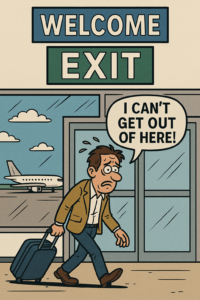
When Security Ate the Terminals
Airports weren’t designed for many of the realities of the modern age. In the 1970s, they had to shoehorn in the first metal detectors for people and carry-on bags. After 9/11, entire swaths of departure halls were consumed by ever-expanding checkpoints.
The old terminals bent under the pressure. Corridors twisted, lines snaked like theme park queues, and the experience felt more like waiting for Space Mountain than catching a flight. I even joked at the time that airports should hire Imagineering to theme the lines—at least then we’d be entertained while standing in endless switchbacks.
Eventually, many of those cramped but architecturally distinctive buildings were torn down. In their place rose vast new terminals: giant halls for security, baggage screening shifted downstairs, and concessions stretched like shopping malls. Yet somehow, even with all that space, you still can’t always find a seat at the gate.
The New Pain Point: Getting Out
But the problem that set me off today isn’t inside the terminal—it’s outside. Getting in, out, and around the airport has become the real bottleneck.
At JFK, rideshare pickups have been pushed further and further away. Terminal 5 riders were first sent to Terminal 7, and now to the subway station. As of this year, Terminal 4 passengers have been added to the list, forced to trek all the way to Howard Beach.
Imagine: you’ve already walked half a mile from gate to curb, and now you need another half-hour to reach your ride. That’s not convenience—it feels like punishment.
AirTrain Sticker Shock
The Port Authority says it’s about congestion and construction. Fair enough. But their fixes feel more like obstacles than solutions.
The AirTrain costs $8.50 each way—triple the subway fare for a fraction of the distance. They halved it briefly over the summer, then quietly raised it again. If the goal is to keep cars out of the airport, why make transit the least appealing option?
Even worse, the AirTrain never actually enters the new terminals. When these billion-dollar facilities were designed, no one thought to reroute the train inside. Instead, you’re left with long walks, crowded stations, and a bill that stings.
And don’t miss the irony: if you ride the AirTrain just to Howard Beach, you can exit for free… into the long-term parking lot. That’s where you’re expected to meet your rideshare, as if this detour were somehow part of a “plan.”
Other Cities Get It Right
The contrast with other airports is glaring:
- Boston Logan: free buses to the subway and even downtown.
- Washington National (DCA): Metro station right at the terminal.
- Dulles (IAD): Metro finally extended all the way after years of delay.
- BWI: free shuttle to the Amtrak/MARC station.
- Chicago O’Hare & Midway: direct ‘L’ train connections.
Even LaGuardia, once the poster child of dysfunction, now has a consolidated rideshare garage close to the new terminal.
So why does JFK, one of the world’s busiest airports, send passengers on a forced march through parking lots?
Shared Rides Are Here to Stay
Just as airports once had to rethink security, it’s time to rethink access. Shared rides are not a passing trend—they’ve replaced taxis as the default way many travelers get to and from the airport.
That means building for them:
- Dedicated staging areas close to terminals.
- Covered walkways for passengers with luggage.
- Affordable transit options that make it easier to skip the car entirely.
Instead, it feels like airports want you to arrive early to spend money inside—but don’t care how long it takes you to leave. That’s not passenger service. That’s passenger neglect.
You Can Check In Any Time You Want, But You Can Never Leave
Airports love to boast about their gleaming terminals and expanded amenities, but all the polish inside doesn’t make up for the frustration of getting out. When you’ve already spent hours navigating checkpoints, walking endless concourses, and waiting for delayed flights, the last thing you want is a half-hour hike to find your ride or a steep surcharge just to escape the property.
Travelers don’t remember the overpriced food courts or duty-free shops—they remember the grind of leaving. If airports keep making exits harder than arrivals, passengers will start voting with their feet—and choosing airports where the journey doesn’t end with a gauntlet.

